| Quantum Mechanics for Engineers |
|
© Leon van Dommelen |
|
2.5 Eigenvalue Problems
To analyze quantum mechanical systems, it is normally necessary to
find so-called eigenvalues and eigenvectors or eigenfunctions. This
section defines what they are.
A nonzero vector  is called an eigenvector of a matrix
  if
if
 is a multiple of the same vector:
 |
(2.13) |
The multiple  is called the eigenvalue. It is just a number.
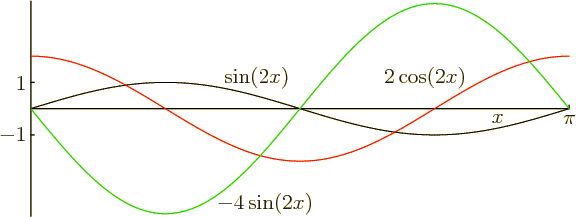
Figure 2.8:
Illustration
of the eigenfunction concept. Function  is shown in
black. Its first derivative
is shown in
black. Its first derivative  , shown in red, is not
just a multiple of . Therefore is
not an eigenfunction of the first derivative operator.
However, the second derivative of is
, shown in red, is not
just a multiple of . Therefore is
not an eigenfunction of the first derivative operator.
However, the second derivative of is 
 ,
which is shown in green, and that is indeed a multiple of
. So is an eigenfunction of the second
derivative operator, and with eigenvalue 4.
,
which is shown in green, and that is indeed a multiple of
. So is an eigenfunction of the second
derivative operator, and with eigenvalue 4.
 |
A nonzero function  is called an eigenfunction of an operator if
 is a multiple of the same function:
 |
(2.14) |
For example,  is an eigenfunction of the operator


 with eigenvalue 1, since
 1 . Another simple example is illustrated in figure
2.8; the function is not an
eigenfunction of the first derivative operator
. However it is an eigenfunction of the
second derivative operator
1 . Another simple example is illustrated in figure
2.8; the function is not an
eigenfunction of the first derivative operator
. However it is an eigenfunction of the
second derivative operator 
 , and with
eigenvalue 4.
, and with
eigenvalue 4.
Eigenfunctions like are not very common in quantum mechanics
since they become very large at large  , and that typically
does not describe physical situations. The eigenfunctions of the
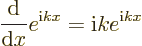
first derivative operator that do appear a lot are of
the form
, and that typically
does not describe physical situations. The eigenfunctions of the
first derivative operator that do appear a lot are of
the form  , where
 and
and  is
an arbitrary real number. The eigenvalue is
is
an arbitrary real number. The eigenvalue is  :
:
Function does not blow up at large ; in
particular, the Euler formula (2.5) says:
The constant is called the “wave number.”
Key Points

- If a matrix turns a nonzero vector into a multiple of that
vector, then that vector is an eigenvector of the matrix, and the
multiple is the eigenvalue.
-
- If an operator turns a nonzero function into a multiple of that
function, then that function is an eigenfunction of the operator,
and the multiple is the eigenvalue.
2.5 Review Questions
-
1.
-
Show that , above, is also an eigenfunction of , but with eigenvalue  . In fact, it is easy to see that the square of any operator has the same eigenfunctions, but with the square eigenvalues.
Solution eigvals-a
-
2.
-
Show that any function of the form  and any function of the form
  , where is a constant called the wave number, is an eigenfunction of the operator , though they are not eigenfunctions of .
Solution eigvals-b
-
3.
-
Show that and , with a constant, are eigenfunctions of the inversion operator  , which turns any function
  into
into  , and find the eigenvalues.
Solution eigvals-c