| Quantum Mechanics for Engineers |
|
© Leon van Dommelen |
|
A.7 Accuracy of the variational method
This note has a closer look at the accuracy of the variational method.
Any approximate ground state wave function  may always be
written as a combination of all the energy eigenfunctions
may always be
written as a combination of all the energy eigenfunctions  ,
,
 , ...:
where  and the
  for
for 
 2, 3, ...are
numerical coefficients. But if the approximation is any good at all,
the coefficient of the correct ground state must be
close to one, while the coefficients of the higher energy
states must be small.
2, 3, ...are
numerical coefficients. But if the approximation is any good at all,
the coefficient of the correct ground state must be
close to one, while the coefficients of the higher energy
states must be small.
The wave function pollution with higher energy states can be related
to the error in energy, call it  , using a few simple
manipulations. First the condition that is normalized,
, using a few simple
manipulations. First the condition that is normalized,
 1, works out to be
since the eigenfunctions  are orthonormal.
Similarly, the expectation energy
are orthonormal.
Similarly, the expectation energy 
 of the approximate solution works out to be
Multiplying the normalization condition by  and subtracting it
from the expression for the expectation energy above gives the error
in energy as:
and subtracting it
from the expression for the expectation energy above gives the error
in energy as:
Note first that since all the terms in the right hand side are
positive, any approximate wave function has more expectation energy
than the ground state . It does not have to be a single energy
eigenfunction of higher energy. But that should not be a surprise.
Nor is it surprising that the expression above shows that the error in
energy will be small if the coefficients of
the incorrect energy eigenfunctions are small and decrease suitably
in magnitude when increases.
However, note that while the errors in wave function are directly
proportional to the coefficients , the error in energy is
proportional to the squares of these coefficients. That makes
the error in energy unexpectedly small, because the square of any
small quantity is much smaller still. (This assumes that the term
small
is defined in a meaningful nondimensional way.)
That small error in energy is great because the computed energy is
important for a number of things, like determining whether a stable
ground state of the supposed form exists in the first place, and if it
does, how fast it interacts with other energy eigenfunctions if there
is uncertainty in energy, chapter 7.
While it may seem obvious that if the approximate wave function is
close to the correct one, then the approximate energy will be close to
the correct one, the reverse is less trivial. If the approximate
energy is close to the exact energy, does that necessarily mean that
entire wave function is close to the exact one? Fortunately,
the answer to that question is usually yes.
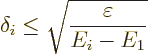
In particular, note from the expression for the error in energy above
that for any coefficient
even in the worst-case scenario that all the error is in the -th
term. From the above, the amount of each polluting
higher-energy eigenfunction function is small if is
small.
But do also note the effect of the denominator. If it too is small, it
may increase the possible error. The worst case occurs for the second
lowest energy state. If the second-lowest energy  is very close
to the ground-state energy , unusual good accuracy in energy may
be required to ensure that the approximate wave function is accurate.
(However, if equals the ground state energy, the second state is
a ground state too; the ground state is then no longer unique. In
that case the error from some valid ground state is described
by the third energy state, not the second.)
is very close
to the ground-state energy , unusual good accuracy in energy may
be required to ensure that the approximate wave function is accurate.
(However, if equals the ground state energy, the second state is
a ground state too; the ground state is then no longer unique. In
that case the error from some valid ground state is described
by the third energy state, not the second.)
Consider also the magnitude of the error in the approximate wave
function. It is defined as
This can be related to the error in energy by noting that from its
given expression
since  is at least as big as
  . Comparing the
expressions above shows that
. Comparing the
expressions above shows that
So if the error in energy is small, the magnitude of the
error in the wave function is too.
The bottom line is that the lower you can get your expectation energy,
the closer you will get to the true ground state energy. In addition
the small error in energy will reflect in a small error in wave
function too.