| Quantum Mechanics for Engineers |
|
© Leon van Dommelen |
|
D.52 Simplification of the Hartree-Fock energy
This note derives the expectation energy for a wave function given by
a single Slater determinant.
First note that if you multiply out a Slater determinant
you are going to get terms, or Hartree products if you want, of the
form
where the numbers  of the single-electron states
can have values from 1 to
of the single-electron states
can have values from 1 to  , but they must be all different. So there are
  such terms: there are
possibilities among
such terms: there are
possibilities among  for the number
  of the
single-electron state for electron 1, which leaves
of the
single-electron state for electron 1, which leaves  remaining
possibilities for the number
remaining
possibilities for the number  of the single-electron state for
electron 2,
of the single-electron state for
electron 2,  remaining possibilities for
  ,
etcetera. That means a total of
,
etcetera. That means a total of 
 terms. As far as the sign of the term is concerned, just don't worry
about it. The only thing to remember is that whenever you exchange
two
terms. As far as the sign of the term is concerned, just don't worry
about it. The only thing to remember is that whenever you exchange
two  values, it changes the sign of the term. It has to be,
because exchanging values is equivalent to exchanging electrons,
and the complete wave function must change sign under that.
values, it changes the sign of the term. It has to be,
because exchanging values is equivalent to exchanging electrons,
and the complete wave function must change sign under that.
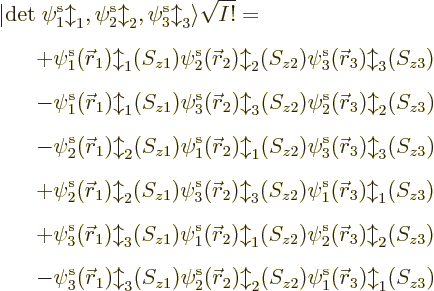
To make the above more concrete, consider the example of a Slater
determinant of three single-electron functions. It writes out to,
taking  to the other side for convenience,
The first two rows in the expansion cover the possibility that
1, with the first one the possibility that 2 and the
second one the possibility that 3; note that then there
are no choices left for . Similarly the second two rows cover
the two possibilities that 2, and the third that
3. You see that there are 3! = 6 Hartree product terms total.
Next, recall that the Hamiltonian consists of single-electron
Hamiltonians  and electron-pair repulsion potentials
 . The expectation value of a single electron
Hamiltonian will be done first. In forming the inner product
. The expectation value of a single electron
Hamiltonian will be done first. In forming the inner product
 , and taking
  apart into
its Hartree product terms as above, you are going to end up with a
large number of individual terms that all look like
apart into
its Hartree product terms as above, you are going to end up with a
large number of individual terms that all look like
Note that overlines will be used to distinguish the wave function in
the right hand side of the inner product from the one in the left hand
side. Also note that to take this inner product, you have to
integrate over  scalar position coordinates, and sum over spin
values.
scalar position coordinates, and sum over spin
values.
But multiple integrals, and sums, can be factored into single
integrals, and sums, as long as the integrands and limits only involve
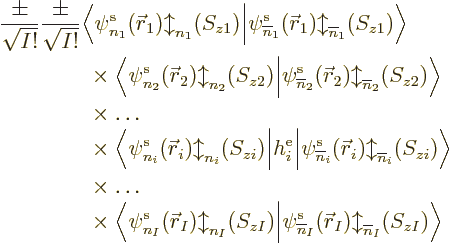
single variables. So you can factor out the inner product as
Now you can start the weeding-out process, because the single-electron
functions are orthonormal. So factors in this product are zero unless
all of the following requirements are met:
Note that
 does not require
 for a nonzero value,
since the single-electron functions are most definitely not
eigenfunctions of the single-electron Hamiltonians, (you would wish
things were that easy!) But now remember that the numbers
in an individual term are all different. So the
numbers
for a nonzero value,
since the single-electron functions are most definitely not
eigenfunctions of the single-electron Hamiltonians, (you would wish
things were that easy!) But now remember that the numbers
in an individual term are all different. So the
numbers  include all the
numbers that are not equal to . Then so do
include all the
numbers that are not equal to . Then so do
 ,
,  , ...,
 ,
,  ,..., because they
are the same. And since must be different from all
of those, it can only be equal to anyway.
,..., because they
are the same. And since must be different from all
of those, it can only be equal to anyway.
So what is left? Well, with all the  values equal to the
corresponding values, all the plain inner products are one on
account of orthonormality, and the only thing left is:
values equal to the
corresponding values, all the plain inner products are one on
account of orthonormality, and the only thing left is:
Also, the two signs are equal, because with all the
values equal to the corresponding values, the wave function term
in the right side of the inner product is the exact same one as in the
left side. So the signs multiply to 1, and you can further factor out
the spin inner product, which is one since the spin states are
normalized:
where for brevity the remaining inner product was called
 . Normally you would call it
  , but
an inner product integral does not care what the integration variable
is called, so the thing has the same value regardless what the
electron
, but
an inner product integral does not care what the integration variable
is called, so the thing has the same value regardless what the
electron  is. Only the value of the single-electron function
number makes a difference.
is. Only the value of the single-electron function
number makes a difference.
Next, how many such terms are there for a given electron and
single-electron function number ? Well, for a given
value for electron , there are possible values left
among  for the value of the first of the other
electrons, then left for the second of the other electrons,
etcetera. So there are a total of
for the value of the first of the other
electrons, then left for the second of the other electrons,
etcetera. So there are a total of 
 such terms. Since
  1/, if you
sum them all together you get a total contribution from terms in which
electron is in state equal to . Summing
over the electrons kills off the factor 1 and so you finally
get the total energy due to the single-electron Hamiltonians as
1/, if you
sum them all together you get a total contribution from terms in which
electron is in state equal to . Summing
over the electrons kills off the factor 1 and so you finally
get the total energy due to the single-electron Hamiltonians as
You might have guessed that answer from the start. Since the inner
product integral is the same for all electrons, the subscripts
have been omitted.
The good news is that the reasoning to get the Coulomb and exchange
contributions is pretty much the same. A single electron to electron
repulsion term between an electron numbered and
another numbered  makes a contribution to the expectation energy
equal to
makes a contribution to the expectation energy
equal to  , and if you
multiply out , you get terms of the general form:
, and if you
multiply out , you get terms of the general form:
You can again split into a product of individual inner products,
except that you cannot split between electrons and since
involves both electrons in a nontrivial way. Still,
you get again that all the other values must be the same as the
corresponding values, eliminating those inner products
from the expression:
For given values of and  , there are
  equivalent terms, since that is the number of possibilities left for
the -values of the other
electrons.
equivalent terms, since that is the number of possibilities left for
the -values of the other
electrons.
Next, and  must together be the
same pair of numbers as and , since they
must be the two numbers left by the set of numbers not equal to
and . But that still leaves two possibilities, they can
be in the same order or in reversed order:
must together be the
same pair of numbers as and , since they
must be the two numbers left by the set of numbers not equal to
and . But that still leaves two possibilities, they can
be in the same order or in reversed order:
The first possibility gives rise to the Coulomb terms, the second to
the exchange ones. Note that the former case represents an inner
product involving a Hartree product with itself, and the latter case
an inner product of a Hartree product with the Hartree product that is
the same save for the fact that it has and reversed,
or equivalently, electrons and exchanged.
Consider the Coulomb terms first. For those the two Hartree products
in the inner product are the same, so their signs multiply to one.
Also, their spin states will be the same, so that inner product will
be one too. And as noted there are equivalent terms for
given and , so for each pair of electrons and
 , and each pair of states and
 , you get one term
with
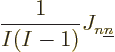
Again, the  are the same regardless of what and
are; they depend only on what and
are. So the subscripts and were left out, after setting
are the same regardless of what and
are; they depend only on what and
are. So the subscripts and were left out, after setting

 and
and 
 .
.
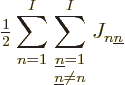
You now need to sum over all pairs of electrons with
and pairs of single-electron function numbers .
Since there are a total of  electron pairs, it takes out the
factor 1/, and you get a contribution to the energy
electron pairs, it takes out the
factor 1/, and you get a contribution to the energy
The factor  was added since for every electron pair, you are
summing both and
was added since for every electron pair, you are
summing both and  , and that
counts the same energy twice.
, and that
counts the same energy twice.
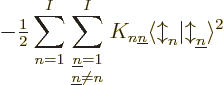
The exchange integrals go exactly the same way; the only differences
are that the Hartree product in the right hand side of the inner
product has the values of and
reversed, producing a change of sign, and that the inner product of
the spins is not trivial. Define
and then the total contribution is
Finally, you can leave the constraint on the sums away
since 
 , so they cancel each other.