|
|
|
|
|
Next: 14.4 Draft: Magic numbers |
|
This section introduces basic terminology and concepts of nuclei. It also gives an overview of the ways that they can decay.
The number of protons in a nucleus is called its “atomic number”  .
. ,
,
 .
.
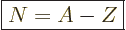
The number of neutrons in a nucleus is its neutron number  .
.
Since neutrons have no charge, they also do not attract the electrons
in the atom or molecule that the nucleus is in. Therefore only the
atomic number ,iso
means equal and
topos
place.)
However, the number of neutrons does have a secondary effect on the chemical properties, because it changes the mass of the nucleus. And the number of neutrons is of critical importance for the nuclear properties. Nuclei with the same number of neutrons are called “isotones.” How clever, to replace the p in isotopes with an n.
The name of a nucleus indicates its number of protons ;hydrogen” means
 ,
, .
.

 .
.
For example, the normal hydrogen nucleus, which consists of a lone proton, is hydrogen-1. The deuterium nucleus, which contains both a proton and a neutron, is hydrogen-2, indicating that it contains two nucleons total. Because it has the same charge as the normal hydrogen nucleus, a deuterium atom behaves chemically almost the same as a normal hydrogen atom. For example, you can create water with deuterium and oxygen just like you can with normal hydrogen and oxygen. Such water is called “heavy water.” Don’t drink it, however; the difference in chemical properties is still sufficient to upset biological systems. Trace amounts are harmless, as can be appreciated from the fact that deuterium occurs naturally. About 1 in 6 500 hydrogen nuclei in water on earth are deuterium ones.
The normal helium nucleus contains two protons plus two neutrons, so
it is called helium-4. There is a stable isotope, helium-3, that has
only one neutron. In the atmosphere, one in a million helium atoms
has a helium-3 nucleus. While normally, there is no big difference
between the two isotopes, at very low cryogenic temperatures they do
behave very differently. The reason is that both protons and neutrons
have spin  ,
,
In terms of symbols, it is conventional to precede the element symbol
by the mass number as a superscript and the atomic number as a
subscript. So normal hydrogen-1 is indicated by
 ,
, ,
, ,
, .
.
Nuclei with the same mass number
Sometimes the element symbol is also followed by the number of
neutrons as a subscript. However, that then raises the question
whether 
 |
(14.1) |
It may also be noted that the atomic number is technically redundant,
since the chemical symbol already implies the number of protons. It
is often left away, because that confuses people who do not remember
the atomic number of every chemical symbol in the periodic table. To
create further confusion, deuterium is often indicated by chemical
symbol 
 .
.
For additional fun, the unstable
hydrogen-3 nucleus, with one proton and two neutrons, is also called
the “tritium” nucleus, or “triton,” and indicated by .
 .
.
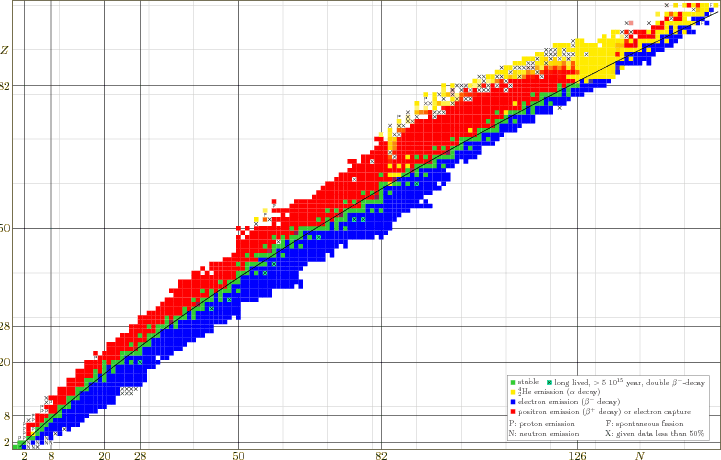
The nuclei mentioned above are just a tiny sample of the total of 256
nuclei that are stable and a much greater number still that are
observed but unstable. It is conventional to represent both the
stable and unstable nuclei in a Chart Of the Nuclides,
(CON), like the one shown in figure 14.1. In the CON,
the tiny green squares are the stable nuclei. Squares of colors other
than green represent unstable nuclei. The horizontal position of each
square gives the number of neutrons magic
values are listed along the horizontal axis).
The vertical position gives the number of protons ,

Before continuing the discussion of the CON, a graphical problem
must be addressed. While you cannot argue about taste, 99.9% of
readers would surely agree that 14.1 is (a)
ugly as hell, and (b) requires a magnifying glass to read. The
Chart Of the Nuclides
is well suited for printing out
on two yards of paper and hanging on the wall of your office in its
full glory. But in a book, it really does not work. It could be made
slightly bigger if printed out sideways, but rotating a monitor with
coffee cups on it and cables attached is a bit awkward. And a crick
in your neck is not that great either.
Based on these considerations, from now on, this book will no longer
plot the neutron number  .
.
But admittedly there are some disadvantages. In the RECON the
isotones (the lines connecting nuclei with the same number of
neutrons) are no longer vertical; now they slope down by 4 .
.
So be it. The good news is that the neutron excess is a lot more
relevant to nuclear stability than the absolute number of nucleons.
For example, at low values of ,
There is an other advantage to the RECON. It has to do with the fact
that those nuclei in which both the number of protons and the number
of neutrons is even, the even-even
nuclei, are found
to have enhanced stability. On the other hand those nuclei in which
both the number of protons and the number of neutrons is odd, the
odd-odd
nuclei, are found to have reduced stability.
Simply put, protons like to pair up, and so do neutrons.
It works out that in the RECON, the even-even and odd-odd nuclei end
up on the same vertical lines. (These vertical lines alternate with
vertical lines of even-odd and odd-even nuclei.) So wherever in
figure 14.2 you see a vertical line with alternating green
and non-green squares, well, the stable green squares are the
even-even nuclei and the non-green ones in between the odd-odd ones.
The pattern very convincingly demonstrates that indeed even-even
nuclei are a lot more stable than odd-odd ones. (In the CON, the
equivalent lines slant by 4
In the intermediate vertical lines in the RECON, where you do not see such a periodic variation of stability, you find the even-odd and odd-even nuclei. Note that on these lines, the vertical extent of green squares is much less than on the adjacent lines with even-even nuclei. This demonstrates graphically that even-even nuclei are not just a lot more stable than odd-odd ones; they are also a lot more stable than even-odd and odd-even ones.
All this also makes it easy to figure out whether a given nucleus is
is even-even or odd-odd in the RECON. Look whether the vertical line
it is on has a series of alternating green and non-green squares; if
so, then that is a line of even-even and odd-odd nuclei. The adjacent
two lines then contain even-odd and odd-even nuclei. (In the region
of heaviest nuclei, you can typically look at the yellow
alpha-decay
nuclei as a substitute for the green
nuclei.) Alternatively, if you see two green squares immediately
above each other in the RECON above  ,
, .
.
Note also that the mass number
If you are really a CON man or woman, there is nothing wrong with that. You can always click on the [con] link provided in the legend of the figure to load the figure in CON format as a separate pdf file. Conversely, if you really like the RECON format and you want to print it and hang it on your wall, click on the [pdf] link instead for a printable version. And either type of pdf can be readily magnified to see details more clearly.
Let's look at some of the details of RECON figure 14.2.
The leftmost green square in the bottom row ))
Like in the CON, isotopes are found on the same horizontal line in the RECON. As mentioned, the horizontal position of each square in RECON figure 14.2 indicates the neutron excess. For example, hydrogen-2 and helium-4 both have equal numbers of protons and neutrons. So they are at the same horizontal position, zero, in the figure. Similarly, hydrogen-1 and helium-3 both have a neutron excess of minus one. The figure shows that stable light nuclei have about the same number of neutrons as protons. However, for the heaviest nuclei, there are about 50% more neutrons than protons. For heavy nuclei, too many closely packed protons would mean too much Coulomb repulsion.
Many isotopes are unstable and decay spontaneously, liberating energy.
For example, consider the blue square to the right of
,
Since charge is conserved, the creation of the positive charge can
only happen if the neutron emits a compensating negative charge; the
neutron does so by emitting an electron. For historical reasons, a
decay process of this type is called beta decay
 -
-electron emission;
initially it was not recognized that the observed radiation was merely
high energy electrons. And the name could not be changed later,
because that would add clarity. (An antineutrino is also emitted, but
it is almost impossible to detect: solar neutrinos will readily travel
all the way through the earth with only a miniscule chance of being
captured.)
Nuclei with too many neutrons tend to use beta decay to turn the excess into protons in order to become stable. Figure 14.2 shows nuclei that suffer beta decay in blue. Since in the decay process they move towards the left, they move towards the stable green area. Although not shown in the figure, a lone neutron also suffers beta decay after about 10 minutes and so turns into a proton.
If nuclei have too many protons rather than too many neutrons, they can turn their excess protons into neutrons by emitting a positron. The positron, the anti-particle of the electron, carries away one unit of positive charge, turning a positively charged proton into a neutral neutron.
However, a nucleus has a much easier way to get rid of one unit of net
positive charge: it can swipe a negatively charged electron from the
atom it is in. This is called electron capture
(EC).
An electron neutrino is emitted in this process.
Electron capture is also called K-capture of L-capture, depending on
the electron shell from which the electron is swiped. It is also
referred to as inverse beta decay,
especially within
the context of “neutron stars.” These stars are so massive that their atoms
collapse under gravity and the electrons and protons combine into
neutrons. These stars then emit enormous amounts of high-energy
neutrinos, taking along a large amount of the available energy of the
star.
Of course, inverse beta decay
is not really inverse
beta decay, because in beta decay the emitted electron does not go
into an empty atomic orbit, and in beta decay no neutrino is absorbed;
instead an antineutrino is emitted.
Positron emission is also often called beta-plus decay
 -
-r
away to save
trees and talk about positons and negatons.
The nuclei that suffer beta-plus decay or electron capture are shown as red squares in figure 14.2. In the decay, a proton turns into a neutron, so the nucleus moves one place down and two places towards the right. That means that these nuclei too move towards the stable green area.
There are a variety of other ways in which nuclei may decay. If the
number of protons or neutrons is really excessive, the nucleus may
just kick out one of the bums instead of convert it. Nuclei that do
that are marked with P,” respectively “N
in figure 14.2,
Similarly, heavy nuclei that are weakened by Coulomb repulsions tend
to just throw some nucleons out. Commonly, a
 -
-
If nuclei are really oversized, they may just fall apart completely; that is called spontaneous fission.
Another process, “gamma decay,” is not shown in figure 14.2. In gamma decay, an excited nucleus transitions to a lower energy state and emits the released energy as very energetic electromagnetic radiation. This is much like the spontaneous decay of excited electron levels in atoms, which too releases electromagnetic radiation. However, the electromagnetic radiation emitted in gamma decay is much more powerful than that emitted by atomic electrons, as nuclear energies are so much higher than those of atomic electrons. Unlike the decays shown in figure 14.2, in gamma decay the type of nucleus does not change; there is no change in the number of protons nor neutrons.
Unlike gamma decay, the nuclear decays shown in figure 14.2 are from their their non-excited “ground state.” But the shown decays are commonly associated with additional gamma radiation, since the decay tends to leave the changed nucleus in an excited state.
Gamma decay as a separate process, not directly caused by another process, is often referred to as an “isomeric transition” (IT) or “internal transition.” In nuclear physics, an isomer is a long-lived excited state of a nucleus.
Besides gamma decay, a second way that an excited nucleus can get rid
of excess energy is by throwing an electron from the atomic electron
cloud surrounding the nucleus out of the atom. You or I would
probably call that something like electron ejection. But what better
name for throwing an electron, that is already outside the nucleus to
start with, completely out of the atom than
internal conversion
(IC)? It can produce some
of that hilarious confusion with the similar sounding term
internal transition.
Internal conversion is usually
included in the term isomeric transition.
Figure 14.2 mixes colors if more than one decay mode occurs for a nucleus. The dominant decay is often immediately followed by another decay process. The subsequent decay is not shown. Data are from NUBASE 2003, without any later updates. The blank square right at the stable region is silver-106, and has a half-life of 24 minutes. Other sources list it as decaying through the expected electron capture or positron emission. But NUBASE 2003 lists that contribution as unknown and only mentions that beta-minus decay is negligible.
Since so many outsiders know what nuclear symbols mean, physicists prefer to use obsolete names to confuse them. Table 14.2 has a list of names used. The abbreviations refer to historical names for decay products of radium (radium emanation, radium A, etc.)
Key Points
- Nuclei consist of protons and neutrons held together by the nuclear force.
- Protons and neutrons are collectively referred to as nucleons.
- Protons also repel each other by the Coulomb force.
- The number of protons in a nucleus is the atomic number
The number of neutrons is the neutron number The total number of nucleons is the mass number or nucleon number
- Nuclei with the same number of protons
correspond to atoms with the same place in the periodic table of chemistry. Therefore nuclei with the same atomic number are called isotopes.
- To promote confusion, nuclei with the same number of neutrons
are called isotones, and nuclei with the same total number of nucleons are called isobars.
- For an example nuclear symbol, consider
It indicates a helium atom nucleus consisting of nucleons, the left superscript, of which are protons, the left subscript. Since it would not be helium if it did not have 2 protons, that subscript is often left away. If you do not remember for, say, you can look it up in a periodic table, like 5.8. But avoid doing so with ,
elementsand .
- Since these rules are too simple, physicists often drag up obsolete symbols like
RE” and “RaFfrom the dark history of nuclear physics. You can look these up in a table above.
- The name for the nucleus with symbol
is helium-4, where the 4 is again the number of nucleons
- An odd mass number
corresponds to either an even-odd nucleus, a nucleus in which the number of protons is even and the number of nucleons odd, or to an odd-even nucleus, in which it is the other way around. An even mass number corresponds to either an even-even nucleus, which tends to have relatively high stability, or to an odd-odd nucleus, which tends to have relatively low stability. The vertical columns in a RECON plot correspond alternatingly to odd and even mass numbers The two types of columns look very different.
- Nuclei can decay by various mechanisms. To promote confusion, emission of a helium-4 nucleus is called alpha decay or
decay. Emission of an electron is called beta decay, or decay, or beta-minus decay, or decay, or negatron emission, or negaton emission, but never electron emission. To do the latter would be severely frowned upon by physicists. Emission of a positron (positon) may be called beta-plus decay, or decay, but either term might be used to also indicate electron capture (EC), depending on who uses the term. Electron capture may also be called K-capture or L-capture or even inverse beta decay, though it is not. More extreme decay mechanisms are proton or neutron emission, and spontaneous fission. Kicking an electron in the electron cloud outside the nucleus completely free of the atom is called internal conversion. Mere emission of electromagnetic radiation is called gamma decay or decay.
- No, this is not a story made up by this book to put physicists in a bad light.


![\begin{figure}\centering
\setlength{\unitlength}{1pt}
\begin{picture}(405,56...
...{\makebox(0,0)[l]{$\fourIdx{4}{2}{}{}{\rm He}$}}
}
\end{picture}
\end{figure}](img3037.gif)



