| Quantum Mechanics for Engineers |
|
© Leon van Dommelen |
|
12.10 Pauli spin matrices
This subsection returns to the simple two-rung spin ladder (doublet)
of an electron, or any other spin  particle for that
matter, and tries to tease out some more information about the spin.
While the analysis so far has made statements about the angular
momentum in the arbitrarily chosen
particle for that
matter, and tries to tease out some more information about the spin.
While the analysis so far has made statements about the angular
momentum in the arbitrarily chosen  -direction, you often also need
information about the spin in the corresponding
-direction, you often also need
information about the spin in the corresponding  and
and  directions. This subsection will find it.
But before getting at it, a matter of notations. It is customary to
indicate angular momentum that is due to spin by a capital  .
Similarly, the azimuthal quantum number of spin is indicated by
.
Similarly, the azimuthal quantum number of spin is indicated by
 . This subsection will follow this convention.
Now, suppose you know that the particle is in the
spin-up
state with 

 angular
momentum in a chosen direction; in other words that it is in the
angular
momentum in a chosen direction; in other words that it is in the
 , or
, or  , state. You want the effect of the
 and
and  operators on this state. In the absence of a
physical model for the motion that gives rise to the spin, this may
seem like a hard question indeed. But again the faithful ladder
operators
operators on this state. In the absence of a
physical model for the motion that gives rise to the spin, this may
seem like a hard question indeed. But again the faithful ladder
operators  and
and  clamber up and down to your rescue!
Assuming that the normalization factor of the  state is
chosen in terms of the one of the state consistent with the
ladder relations (12.9) and (12.10), you have:
state is
chosen in terms of the one of the state consistent with the
ladder relations (12.9) and (12.10), you have:
By adding or subtracting the two equations, you find the effects of
and on the spin-up state:
It works the same way for the spin-down state
 :
:
You now know the effect of the and angular momentum operators
on the -direction spin states. Chalk one up for the ladder
operators.
Next, assume that you have some spin state that is an arbitrary
combination of spin-up and spin-down:
Then, according to the expressions above, application of the
spin operator will turn it into:
while the operator turns it into
And of course, since and are the eigenstates of
 ,
,
If you put the coefficients in the formula above, except for the
common factor  , in little 2
  2 tables,
you get the so-called
2 tables,
you get the so-called Pauli spin matrices
:
 |
(12.15) |
where the convention is that  multiplies the first column of the
matrices and
multiplies the first column of the
matrices and  the second. Also, the top rows in the matrices
produce the spin-up part of the result and the bottom rows the spin
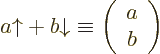
down part. In linear algebra, you also put the coefficients and
together in a vector:
the second. Also, the top rows in the matrices
produce the spin-up part of the result and the bottom rows the spin
down part. In linear algebra, you also put the coefficients and
together in a vector:
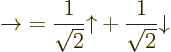
You can now go further and find the eigenstates of the and operators in terms of the
eigenstates and of the operator. You
can use the techniques of linear algebra, or you can guess. For
example, if you guess 1,
so 1 is an eigenstate of with eigenvalue
, call it a  ,
,
spin-right
, state. To normalize the state, you still
need to divide by  :
:
Similarly, you can guess the other eigenstates, and come up with:
 |
(12.16) |
Note that the square magnitudes of the coefficients of the states are
all one half, giving a 50/50 chance of finding the -momentum up or
down. Since the choice of the axis system is arbitrary, this can be
generalized to mean that if the spin in a given direction has an
definite value, then there will be a 50/50 chance of the spin in any
orthogonal direction turning out to be or
 .
.
You might wonder about the choice of normalization factors in the spin
states (12.16). For example, why not leave out the common
factor  in the
  , (negative spin, or
spin-left), state? The reason is to ensure that the
-direction ladder operator
, (negative spin, or
spin-left), state? The reason is to ensure that the
-direction ladder operator  and the
-direction one
and the
-direction one  , as obtained by
cyclic permutation of the ones for , produce real, positive
multiplication factors. This allows relations valid in the
-direction (like the expressions for triplet and singlet
states) to also apply in the and directions. In addition,
with this choice, if you do a simple change in the labeling of the
axes, from
, as obtained by
cyclic permutation of the ones for , produce real, positive
multiplication factors. This allows relations valid in the
-direction (like the expressions for triplet and singlet
states) to also apply in the and directions. In addition,
with this choice, if you do a simple change in the labeling of the
axes, from  to
to  or
or  , the form of the Pauli spin
matrices remains unchanged. The and
, the form of the Pauli spin
matrices remains unchanged. The and  states of
positive -, respectively -momentum were chosen a
different way: if you rotate the axis system 90
states of
positive -, respectively -momentum were chosen a
different way: if you rotate the axis system 90 around
the or axis, these are the spin-up states along the new
-axis, the -axis or -axis in the system you
are looking at now, {D.68}.
around
the or axis, these are the spin-up states along the new
-axis, the -axis or -axis in the system you
are looking at now, {D.68}.