|
|
|
|
|
Next: A.29 WKB solution near the turning points |
|
|
|
|
|
|
Next: A.29 WKB solution near the turning points |
|
WKB theory provides simple approximate solutions for the energy eigenfunctions when the conditions are almost classical, like for the wave packets of chapter 7.11. The approximation is named after Wentzel, Kramers, and Brillouin, who refined the ideas of Liouville and Green. The bandit scientist Jeffreys tried to rob WKB of their glory by doing the same thing two years earlier, and is justly denied all credit.
The WKB approximation is based on the rapid spatial variation of
energy eigenfunctions with almost macroscopic energies. As an
example, figure A.16 shows the harmonic oscillator energy
eigenfunction  .
.


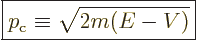
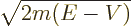
The WKB approximation is most appealing in terms of the classical
momentum
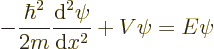

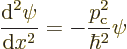
Now under almost classical conditions, a single period of oscillation
of the wave function is so short that normally



It turns out that to make the above expression work over more than one
period, it is necessary to replace 
 .
.constants
 .
.
In short, the WKB approximation of the wave function is,
{D.46}:


If you ever glanced at notes such as {D.12},
{D.14}, and {D.15}, in which the
eigenfunctions for the harmonic oscillator and hydrogen atom were
found, you recognize what a big simplification the WKB approximation
is. Just do the integral for 
In many applications, it is more convenient to write the WKB
approximation in terms of a sine and a cosine. That can be done by
taking the exponentials apart using the Euler formula
(2.5). It produces


As an application, consider a particle stuck between two impenetrable
walls at positions 
 .
. ,
, ,,
,,

 ,
,
 ,
,
 ,
,
It does get a bit more tricky for a case like the harmonic oscillator
where the particle is not caught between impenetrable walls, but
merely prevented to escape by a gradually increasing potential.
Classically, such a particle would still be rigorously constrained
between the so called “turning points” where the potential energy 
 ,
,
A further complication arises since the WKB approximation becomes inaccurate in the immediate vicinity of the turning points. The problem is the requirement that the classical momentum can be approximated as a nonzero constant on a small scale. At the turning points the momentum becomes zero and that approximation fails.
However, it is possible to solve the Hamiltonian eigenvalue problem
near the turning points assuming that the potential energy is not
constant, but varies approximately linearly with position,
{A.29}. Doing so and fixing up the WKB solution away
from the turning points produces a simple result. The classical WKB
approximation remains a sine, but at the turning points, 
Therefore, the expression for the energy eigenvalues becomes:
The WKB approximation works fine in regions where the total energy ..tunnel
through, after a popular way for criminals to
escape from jail. To use the WKB approximation in these regions, just
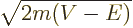
rewrite it in terms of the magnitude 

Key Points
- The WKB approximation applies to situations of almost macroscopic energy.
- The WKB solution is described in terms of the classical momentum
and in particular its antiderivative .
- The wave function can be written as (A.209) or (A.210), whatever is more convenient.
- For a particle stuck between impenetrable walls, the energy eigenvalues can be found from (A.212).
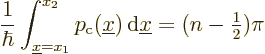
- For a particle stuck between a gradually increasing potential at both sides, the energy eigenvalues can be found from (A.213).
- The
tunnelingwave function in regions that classically the particle is forbidden to enter can be approximated as (A.214). It is in terms of the antiderivative
Use the equation
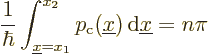


In this case, the WKB approximation produces the exact result, since the classical momentum really is constant. If there was a force field in the pipe, the solution would only be approximate.
Use the equation


 ,
, .
.
In this case too, the WKB approximation produces the exact energy eigenvalues. That, however, is just a coincidence; the classical WKB wave functions are certainly not exact; they become infinite at the turning points. As the example


![\begin{figure}\centering
\setlength{\unitlength}{1pt}
\begin{picture}(405,70...
... \put(-113,62){\makebox(0,0)[l]{$p_{\rm {c}}^2/2m$}}
\end{picture}
\end{figure}](img5032.gif)