| Quantum Mechanics for Engineers |
|
© Leon van Dommelen |
|
D.18 Eigenfunctions of commuting operators
Any two operators  and
and  that commute,
  , have a common set
of eigenfunctions, provided only that each has a complete set of
eigenfunctions. (In other words, the operators do not necessarily
have to be Hermitian. Unitary, anti-Hermitian, etcetera, operators
all qualify.)
, have a common set
of eigenfunctions, provided only that each has a complete set of
eigenfunctions. (In other words, the operators do not necessarily
have to be Hermitian. Unitary, anti-Hermitian, etcetera, operators
all qualify.)
First note the following:
if  is an eigenfunction of with eigenvalue
  , then
 is either also an eigenfunction of with eigenvalue
or is zero.
is either also an eigenfunction of with eigenvalue
or is zero.
To see that, note that since and commute 

 which is
  . Comparing start and end, the
combination must be an eigenfunction of with
eigenvalue if it is not zero. (Eigenfunctions may not be zero.)
. Comparing start and end, the
combination must be an eigenfunction of with
eigenvalue if it is not zero. (Eigenfunctions may not be zero.)
Now assume that there is just a single independent eigenfunction
 for each distinct eigenvalue of . Then if
is nonzero, it can only be a multiple of that single
eigenfunction. By definition, that makes an eigenfunction
of too, with as eigenvalue the multiple. On the other hand, if
is zero, then is still an eigenfunction of ,
now with eigenvalue zero. So under the stated assumption, and
have the exact same eigenfunctions, proving the assertion of this
derivation.
for each distinct eigenvalue of . Then if
is nonzero, it can only be a multiple of that single
eigenfunction. By definition, that makes an eigenfunction
of too, with as eigenvalue the multiple. On the other hand, if
is zero, then is still an eigenfunction of ,
now with eigenvalue zero. So under the stated assumption, and
have the exact same eigenfunctions, proving the assertion of this
derivation.
However, frequently there is degeneracy,
i.e. there is
more than one eigenfunction 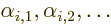 for a
single eigenvalue . Then the fact that, say,
for a
single eigenvalue . Then the fact that, say,  is
an eigenfunction of with eigenvalue no longer means that
is a multiple of
is
an eigenfunction of with eigenvalue no longer means that
is a multiple of  ; it only means that
is some combination of all of
. Which means that
is not in general an eigenfunction of .
; it only means that
is some combination of all of
. Which means that
is not in general an eigenfunction of .
To deal with that, it has to be assumed that the problem has been
numerically approximated by some finite-dimensional one. Then and
will be matrices, and the number of independent eigenfunctions (or
rather, eigenvectors now) of and will be finite and equal.
That allows the problem to be addressed one eigenfunction at a time.
Assume now that  is an eigenfunction of , with eigenvalue
 , that is not yet an eigenfunction of too. By completeness, it
can still be written as a combination of the eigenfunctions of ,
and more particularly as
, that is not yet an eigenfunction of too. By completeness, it
can still be written as a combination of the eigenfunctions of ,
and more particularly as  where
where
 is a combination of the eigenfunctions of with
eigenvalue and
is a combination of the eigenfunctions of with
eigenvalue and  a combination of the eigenfunctions of
with other eigenvalues. There must be such eigenfunctions with
nonzero, because without using the you cannot
create an equal number of independent eigenfunctions of as of .
By definition
a combination of the eigenfunctions of
with other eigenvalues. There must be such eigenfunctions with
nonzero, because without using the you cannot
create an equal number of independent eigenfunctions of as of .
By definition
but that must mean that
since if it is not,  cannot make up the difference; as seen
earlier, only consists of eigenfunctions of that do
not have eigenvalue . According to the above equation,
, which is already an eigenfunction of with
eigenvalue , is also an eigenfunction of with eigenvalue .
So replace one of the ,
cannot make up the difference; as seen
earlier, only consists of eigenfunctions of that do
not have eigenvalue . According to the above equation,
, which is already an eigenfunction of with
eigenvalue , is also an eigenfunction of with eigenvalue .
So replace one of the ,  ,...with
. (If you write in terms of the
, ,..., then the function you replace
may not appear with a zero coefficient.) Similarly replace an
eigenfunction of with eigenvalue with . Then
and have one more common eigenfunction. Keep going in this way
and eventually all eigenfunctions of are also eigenfunctions of
and vice versa.
,...with
. (If you write in terms of the
, ,..., then the function you replace
may not appear with a zero coefficient.) Similarly replace an
eigenfunction of with eigenvalue with . Then
and have one more common eigenfunction. Keep going in this way
and eventually all eigenfunctions of are also eigenfunctions of
and vice versa.
Similar arguments can be used recursively to show that more generally,
a set of operators 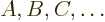 that all commute have a single
common set of eigenfunctions. The trick is to define an artificial
new operator, call it
that all commute have a single
common set of eigenfunctions. The trick is to define an artificial
new operator, call it  , that has the common eigenfunctions of
and , but whose eigenvalues are distinct for any two eigenfunctions
unless these eigenfunctions have the same eigenvalues for both and
. Then the eigenfunctions of , even if you mess with them,
remain eigenfunctions of and . So go find common
eigenfunctions for and
, that has the common eigenfunctions of
and , but whose eigenvalues are distinct for any two eigenfunctions
unless these eigenfunctions have the same eigenvalues for both and
. Then the eigenfunctions of , even if you mess with them,
remain eigenfunctions of and . So go find common
eigenfunctions for and  .
.
The above derivation assumed that the problem was finite-dimensional, or
discretized some way into a finite-dimensional one like you do in numerical
solutions. The latter is open to some suspicion, because even the
most accurate numerical approximation is never truly exact.
Unfortunately, in the infinite-dimensional case the derivation gets much
trickier. However, as the hydrogen atom and harmonic oscillator
eigenfunction examples indicate, typical infinite systems in nature do
obey the theorem anyway.




